
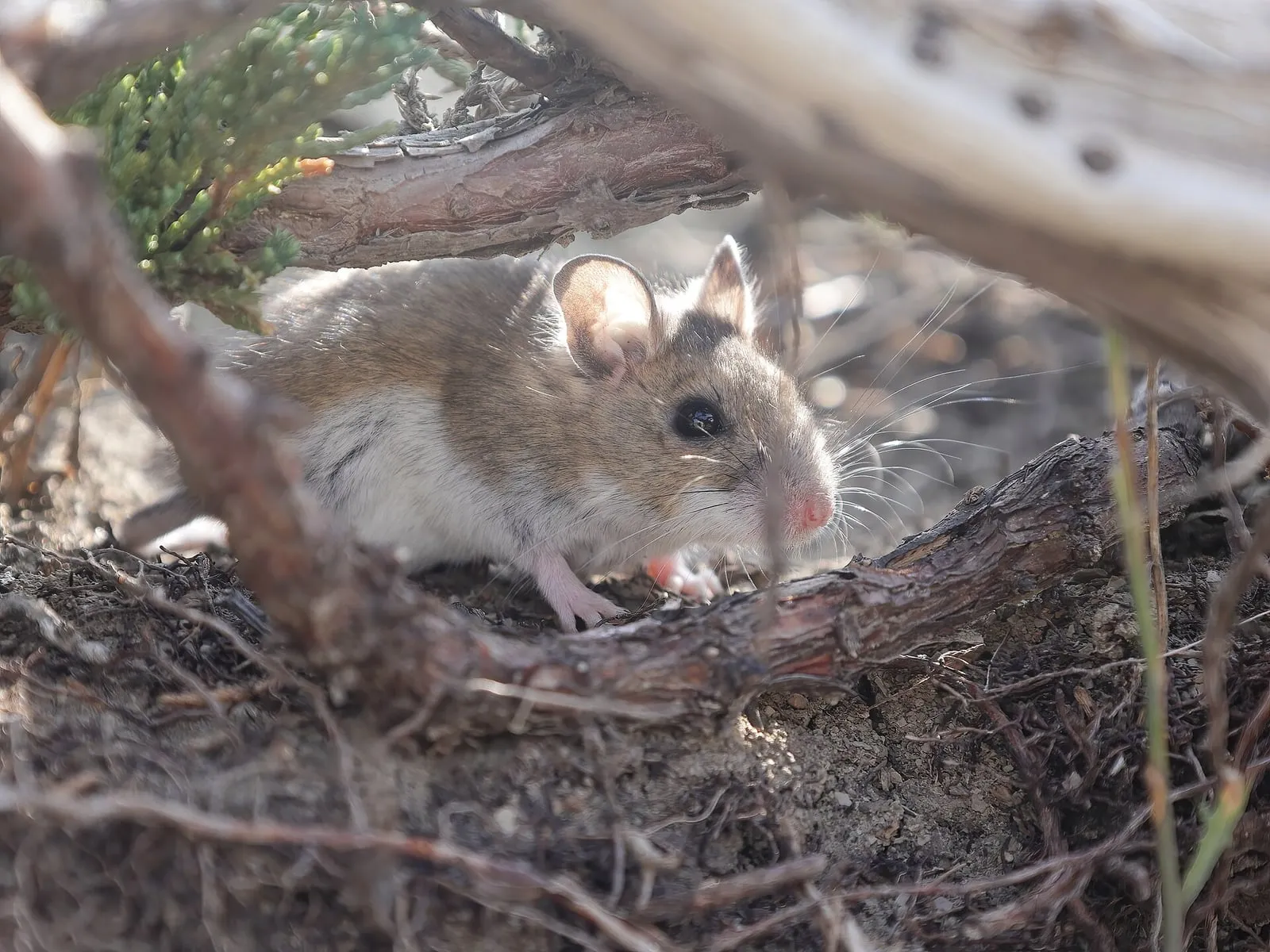


The two-tone mouse
The deer mouse is the good-looking one. It has a warm brown or grayish-brown back, a snow-white belly and white feet, with a clean line where the two colors meet. The eyes are large and dark, the ears big and thin, and the tail is furred and two-toned: dark on top, white underneath, as if someone ran a paintbrush down one side. The body runs about three to four inches, and the tail adds a few more.
Compare that with the house mouse, which is gray-brown everywhere, with a bare, scaly-looking tail. Once you’ve seen the two side by side it’s hard to mix them up. Their droppings are another matter. Deer mouse and house mouse droppings are about the same size and shape, so if you find droppings in the shed without a mouse to go with them, treat them as if they came from a deer mouse.
Most field guides still call this animal Peromyscus maniculatus. A 2019 genetic revision split that species into several, and under that scheme the deer mice of the interior West, Idaho included, are often listed as the western deer mouse, Peromyscus sonoriensis. Not every mammalogist accepts the split yet. For a homeowner it changes nothing, since it’s the same mouse in the same woodpile.
Where they turn up around Boise
Deer mice are native, and they live wherever there’s open ground. In the Treasure Valley that means the sagebrush and grass of the Boise foothills, brushy stretches along the Boise River and the irrigation canals, fence rows and field edges, and the strips of undeveloped land that still sit between subdivisions. UC IPM notes that they’re less common in built-up residential areas unless there are large parks or fields nearby. If your back fence faces the foothills or a field, you’ll see more of them than someone in a dense older neighborhood will.
They come indoors less for the house than for the outbuildings. Deer mice like structures that sit quiet: the garden shed, a detached garage, the travel trailer parked in the side yard, a cabin up near Idaho City that’s closed from October to May. They move in as the weather turns, they don’t hibernate, and they store food. It’s common to open a toolbox or a pair of work boots in spring and find a neat stash of dog food or birdseed, plus a nest made from whatever was handy, often the stuffing from a camper cushion.
Hantavirus in Idaho
Deer mice are the main carrier of Sin Nombre virus, the cause of hantavirus pulmonary syndrome (HPS). The mice shed it in their urine, droppings and saliva. People usually get infected by breathing it in, when fresh droppings or nesting material get stirred up and the dust hangs in the air. The classic exposure is someone sweeping out a closed-up shed in April.
Central District Health says about one Sin Nombre infection a year is reported in Idaho, with the risk higher in spring and summer when rodent populations are up. Idaho has had cases, including deaths, since the virus was first identified in the 1990s. When it does happen it’s serious: the CDC says about 38 percent of people who develop respiratory symptoms may die. So the odds are low, but the cost of getting it wrong is high enough that cleanup should be done the slow, careful way every time.
The CDC’s method, in short:
- Open doors and windows and leave the space for 30 minutes before you start.
- Put on rubber or plastic gloves.
- Mix a fresh bleach solution, 1.5 cups of household bleach per gallon of water, and soak the droppings, urine spots and nest material. Let it sit 5 minutes.
- Wipe it up with paper towels, bag it, and put it in a covered trash can. Double-bag any dead mice.
- Mop or wipe the area with the same solution, then take off the gloves and wash your hands with soap and warm water.
No sweeping, no shop vac, no leaf blower. The full instructions are on the CDC rodent cleanup page, and we go into more detail in hantavirus, deer mice and safe cleanup. For a building with a heavy infestation, like a cabin that’s been full of mice for years, the CDC calls for extra protective gear including a respirator, and suggests contacting your local or state health department first.
If you get sick within a couple of months of cleaning up after rodents, with fever, fatigue and aching thighs, hips or back, tell your doctor about the exposure. It helps them think of hantavirus early.
Sheds, campers and garages
Deer mice fit through the same quarter-inch gaps as house mice, and most sheds have plenty of them. Start at the bottom of the building, under the door and wherever the siding meets the slab or the skids. A door sweep, a strip of 1/4-inch hardware cloth along the base, or copper wool with a bead of caulk over it in the smaller gaps will close most of them.
Food is the other half. Birdseed, grass seed, dog food and chicken feed belong in metal cans or hard plastic bins with locking lids. A paper bag on the shed floor is a pantry. Hang bird feeders away from buildings and clean up the spilled seed under them, since that’s a winter food supply. Cover matters too: stack firewood off the ground and away from walls, swap cardboard boxes for lidded totes, and cut tall grass back from the foundation.
A camper needs its own pass before you park it for winter. Take out all the food, close the vents, and check where hoses and wires come through the floor. Some owners set traps inside so they find out in March rather than June.
Snap traps work well on deer mice. Bait them with peanut butter or a few sunflower seeds and set them along walls. Wear gloves when you handle traps or dead mice, and spray the mouse and trap with disinfectant before you bag them.
If fresh droppings keep showing up after you’ve sealed things, or you have a cabin, barn or shop where mice have obviously been living for a while, a free rodent inspection will tell you which rodent you have and how much activity there is. For the house itself, our rodent control service is usually exterior baiting, and you can contact us to set it up.