


It isn’t a mole
People in Boise call them mole hills, and if you grew up somewhere with moles, that’s a fair guess. Idaho has exactly one native mole, though, the coast mole, and it’s known from only a handful of records in west-central Idaho. A mound in a Treasure Valley lawn is a pocket gopher mound. That matters, because mole remedies like grub control don’t do anything for an animal that eats roots.
The shape tells you. When a gopher digs, it shoves the loose soil up a short side tunnel and out onto the surface, then plugs the hole behind it. That leaves a mound usually a foot to a foot and a half across and several inches high, shaped like a fan or horseshoe when you look down at it, with the plug off to one side as a small round dimple. A mole hill is round, like a little volcano, with the plug in the middle. Fresh gopher mounds are dark and moist, and a busy gopher can make several in a day.
Gophers leave a different sign in winter. When there’s snow on the ground, they tunnel up into it and pack those snow tunnels with soil. After the melt you find ropes of dirt lying on top of the grass, sometimes right next to the flattened trails voles leave. The vole page covers that other half of the spring mess.
The animal you won’t see
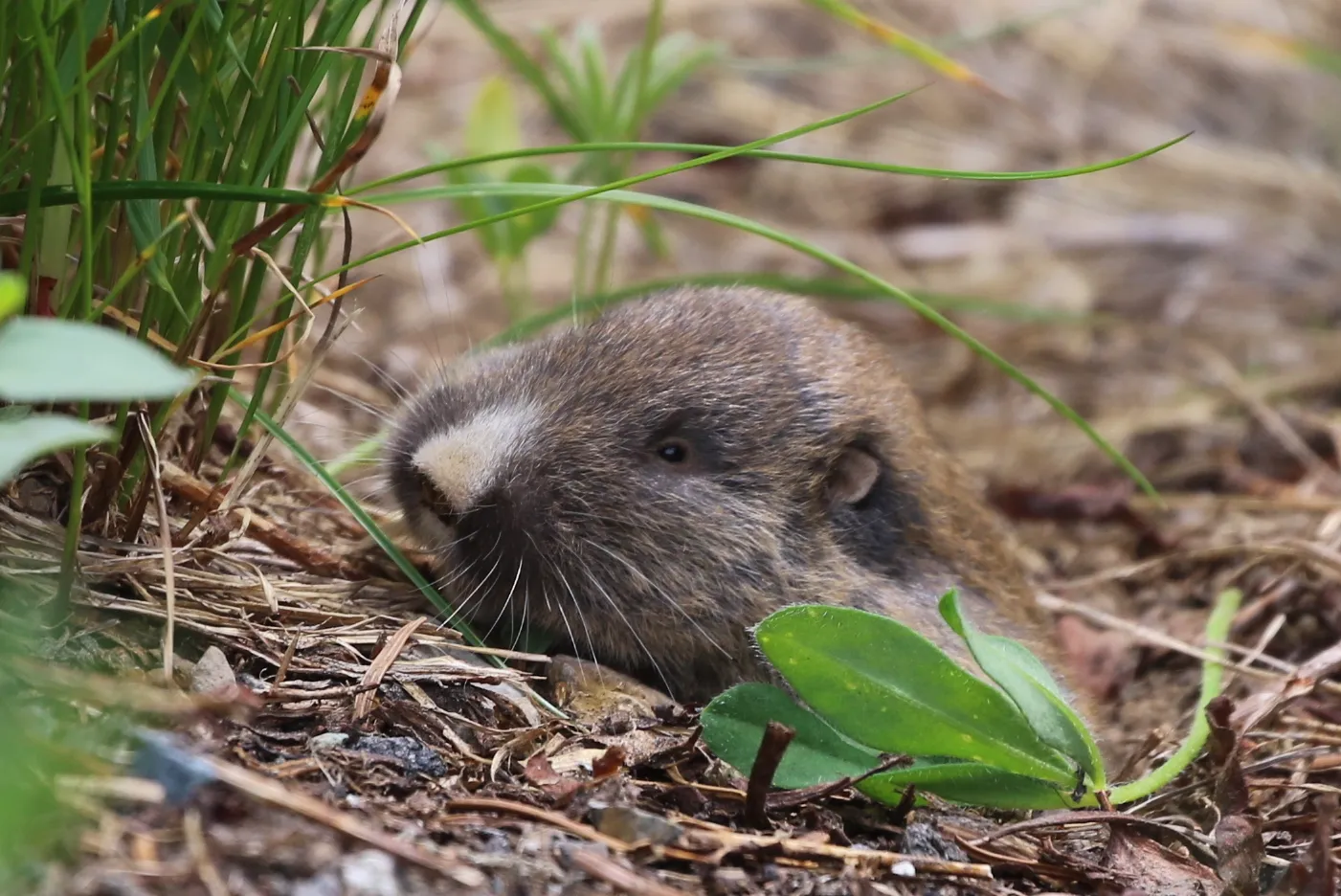
Gophers spend nearly their whole lives underground and rarely go more than a couple of feet from an opening, so most people never see one. It’s built for the work: a thick body, powerful shoulders, long front claws, tiny eyes and ears, and four big yellow-orange front teeth that stay outside its lips so it can chew through soil without getting a mouthful. The “pocket” is a pair of fur-lined cheek pouches on the outside of its face, which it stuffs with roots and stems to carry back through the tunnels. The short, nearly bare tail is sensitive and helps it feel its way when it backs up a tunnel.
The northern pocket gopher has the widest range of any pocket gopher in North America and turns up across Idaho, from valley grassland and sagebrush to mountain meadows. It’s around six and a half to ten inches long counting the tail. The Treasure Valley also has Townsend’s pocket gopher, a bigger animal at roughly 9 to 11 inches overall that favors deep, moist soils in river bottoms and irrigated farmland along the Snake River drainage. The specimen the species was described from was probably collected near Nampa. Unless you have one in your hand, you can’t tell the two apart, and the damage and the fixes are the same for both.
Where they dig, and what they wreck
Gophers want soil they can dig and roots they can eat. Deep, loose, well-drained ground is ideal, and irrigation makes it better by keeping plants lush and the soil workable all summer. That describes a lot of the valley: alfalfa and pasture edges, orchard ground, canal banks, and the newer subdivisions built on old farmland, where lawns and landscape beds went in right on top of established burrow systems. Foothills lots that back onto open grassland get them moving in from the edge. Alfalfa and clover, with their big taproots, are about the best gopher food there is, so a lot bordering an old hay field is a likely spot. Very sandy soil that won’t hold a tunnel keeps numbers down, and so does heavy, waterlogged clay.
The mounds smother grass, dull mower blades and leave a lumpy lawn with soft spots that are easy to turn an ankle in. The worse damage is out of sight. Gophers eat roots, bulbs and tubers from below, so a healthy plant can wilt and fall over for no visible reason, or a whole row of carrots can disappear from underneath. They also pull plants down into the tunnel. In winter, when food is scarce, they’ll chew bark around the base of young trees, shrubs and vines below the soil line.
Irrigation takes a beating too. Gophers gnaw on flexible plastic lines, drip tubing most of all, and their tunnels can carry irrigation water off down a hole, wash out soil and undermine ditch banks. If one section of the yard suddenly won’t stay watered, or you can watch water vanish into the lawn, a gopher tunnel is a good suspect.
Handling gophers yourself
We don’t trap gophers, so this part is up to you. Pocket gophers aren’t a protected species in Idaho, and Extension guidance treats trapping as the standard, safe approach for a yard. The University of Idaho’s PNW 627 walks through it with photos. The short version:
- Rake old mounds flat. Only fresh mounds tell you where the gopher is working now.
- Probe on the plug side of a fresh mound, about 8 to 12 inches out. When the probe drops a couple of inches, you’ve hit the main tunnel.
- Set traps in pairs facing opposite directions. Pincer traps like the Macabee or Cinch style work, and so do box traps.
- Stake them down and cover the opening to keep light out.
- If nothing happens in a day or two, move the traps.
Protect new plantings before they go in. Line raised beds with wire mesh before you fill them, and plant shrubs and young trees in wire baskets. UC IPM recommends 1/2- to 3/4-inch mesh, and for a buried barrier along a bed, setting it at least two feet deep with a few inches bent outward at the bottom. For irrigation, bury drip and sprinkler lines in a jacket of coarse gravel, an inch or more in diameter and six to eight inches around the pipe. It won’t stop every gopher, but it discourages chewing.
Go slow on poison. Gopher baits go underground in the tunnel, and some of them are hazardous to dogs and other animals that dig up or eat a poisoned gopher. Read the label start to finish and only use a product labeled for your site.
Save your money on the folk remedies. UC IPM says no repellent on the market reliably protects plants from gophers, vibrating and ultrasonic stakes haven’t worked in research trials, and chewing gum down the hole is on its list of methods that don’t work. Gophers, as they put it, don’t frighten easily.
If you can’t tell whether the mounds are gophers, voles, ground squirrels or something else, book a free rodent inspection and we’ll tell you what’s there. While we’re out, we’ll check whether anything is also getting into the house, garage or crawlspace, which is the part our rodent control service covers. You can also contact us first.