
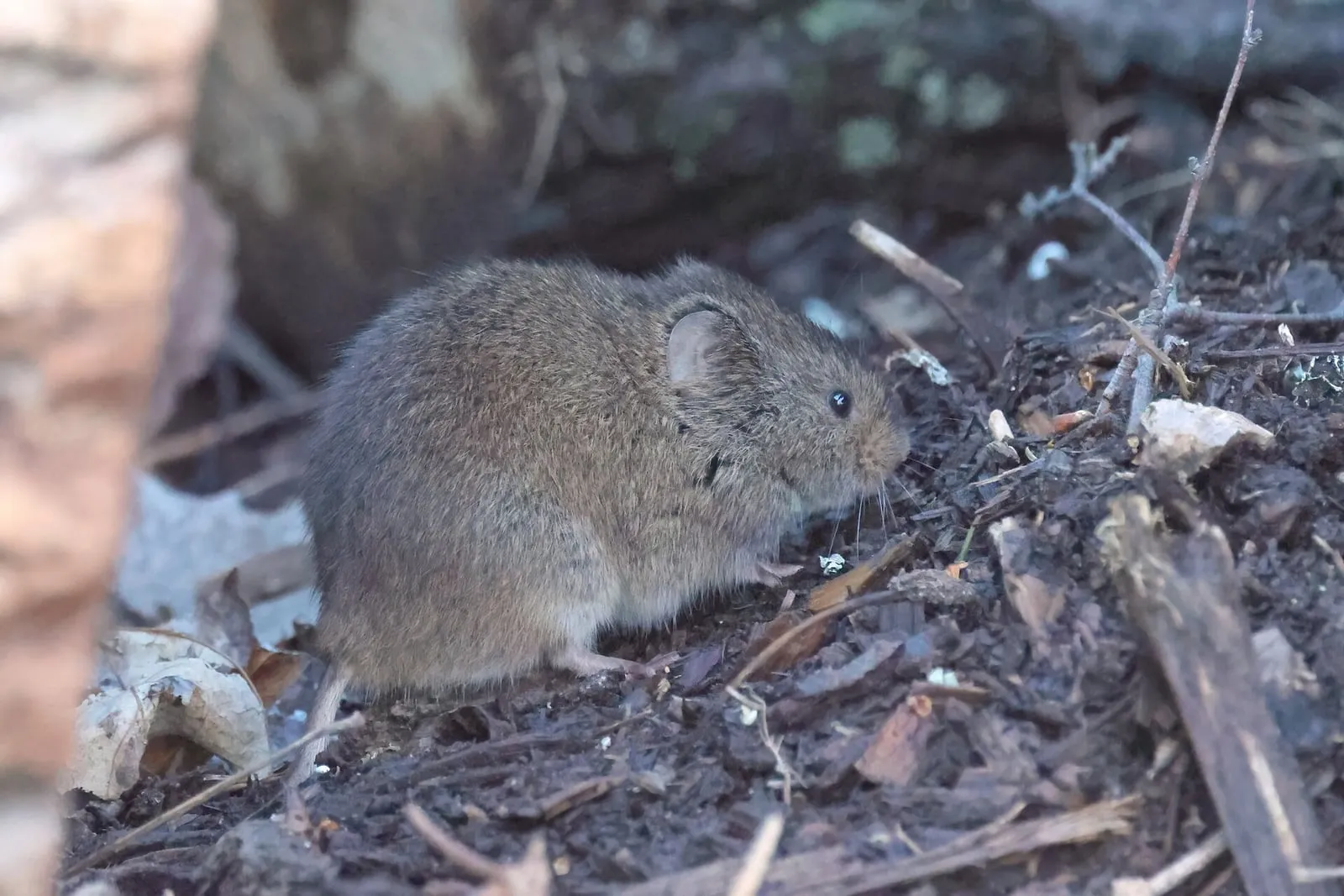


Voles don’t hibernate. They spend the winter under the snow, where hawks and owls can’t see them, clipping grass and building runways between their nests. When a Boise winter leaves snow on the lawn for a few weeks, they build a whole road system you only find out about when it melts.
What shows up is a network of trails about one to two inches wide, worn or clipped down to the soil and wandering across the lawn, often toward a bed edge, fence or foundation. Along them you’ll find small open holes, wads of shredded grass where the voles nested, and droppings. We wrote a whole post on vole lawn damage after snowmelt in Boise because it’s one of the most common “what happened to my yard” questions every March.
The lawn usually comes back
The grass is usually less dead than it looks. Voles mostly eat the blades and leave the crowns and roots, so a light raking to clear the debris and a few weeks of spring growth fill most runways back in. Overseed any patches that stay bare.
Young trees are the real worry
Under snow cover, voles also chew bark off the base of young trees, shrubs and vines, often right at the soil line, where you won’t notice until spring. Look for patches of bare wood covered in small, irregular gnaw marks about an eighth of an inch wide. If the chewing goes all the way around the trunk, the plant is girdled. A girdled sapling usually leafs out once on stored energy and then fails.
New plantings are most at risk: fruit trees, arborvitae, young maples and anything else with thin bark. If you’re also watching those trees for insects, our post on treating fruit-bearing trees without spraying pairs well with the vole guards described further down.
In the garden, voles go after bulbs, carrots, potatoes and other roots from underneath, and they’ll clip seedlings flush with the ground.
What a vole looks like
A vole looks like a mouse built for comfort: heavy in the body, short in the legs and tail, with a blunt, rounded face and small ears that barely show through the fur. The coat is a coarse brownish-gray with darker tips, and the tail is two-toned, darker on top. Most adults are four and a half to five and a half inches long counting the tail, according to University of Idaho Extension, and a well-fed one can reach about seven and a half.
Idaho has several kinds of voles, and telling them apart takes a specimen in hand and a good key. The University of Idaho calls the meadow vole the most common in the state, and it’s the one people find in lawns, pastures and gardens. The montane vole lives here too and leans toward drier grass and sagebrush country. They look alike, eat the same things and respond to the same fixes, so for a homeowner it doesn’t much matter which one you have. You’re unlikely to get a good look anyway. Voles keep to cover and cross open ground in short dashes along their own trails.
Why the valley grows so many
Voles want something green to eat and something overhead to hide under, and irrigation gives the valley plenty of both. Canal and ditch banks grow tall grass all season, and so do the grassy margins along the Boise River greenbelt, pasture edges and weedy fence lines. Plenty of newer subdivisions sit on what used to be hay ground and pasture, and the voles in those fields stayed when the fields became lawns. A thick lawn, a groundcover bed, landscape fabric, a heavy layer of bark mulch or the unmowed strip behind the shed all suit them fine.
Numbers swing hard from year to year. Extension specialists describe smaller population peaks every four to six years and big outbreaks roughly every ten to twelve, though the timing isn’t regular. A female can breed at about five weeks old, so a population can climb fast when food and cover are good. In a peak year it can seem like every yard on the street has voles at once, and that’s usually because they do.
Cutting them back
Most vole problems shrink a lot once the cover is gone, so start there. Keep the lawn mowed through fall so it doesn’t go into winter long and matted, and cut tall grass along ditch banks, fence lines and the back of the lot. Pull mulch back so there’s a few inches of bare soil around the base of each tree and shrub, and keep mulch beds to a couple of inches deep. UC IPM suggests a vegetation-free circle of about four feet around young trees.
For young trees, wrap the base in a cylinder of hardware cloth with 1/4-inch mesh, buried a few inches into the soil and tall enough to stay above typical snow. University of Idaho guidance uses 3/8-inch wire set about six inches below ground. Either way, leave room for the trunk to grow.
Ordinary wooden mousetraps work on voles. Set them flush with the ground at right angles across an active runway, and stake them down so a hawk or cat can’t drag them off. Bait usually isn’t needed, since voles trip them on their regular rounds, but a dab of peanut butter or a slice of apple helps. Check traps daily, wear gloves, and keep them where kids and pets can’t reach. UC IPM notes that a small garden may need a dozen or more traps to make a dent.
Be careful with bait. Vole baits are sold at farm and garden stores, but many have to go in tamper-resistant bait stations, some are restricted to licensed applicators, and all of them can poison dogs, cats and birds. Read the label for your exact site, and if it doesn’t list voles and lawns or landscapes, don’t use it there.
Leave the hawks and owls alone, since they help. Extension specialists are blunt, though, that predators alone won’t hold down a vole outbreak.
Voles, gophers or something else
We don’t trap or treat voles in the yard. If you can’t tell what’s making the damage, or it keeps spreading after you’ve cleared the cover, book a free rodent inspection and we’ll identify it. If mice are getting into the house or garage too, our rodent control service handles that part. Or get in touch with a question first.