
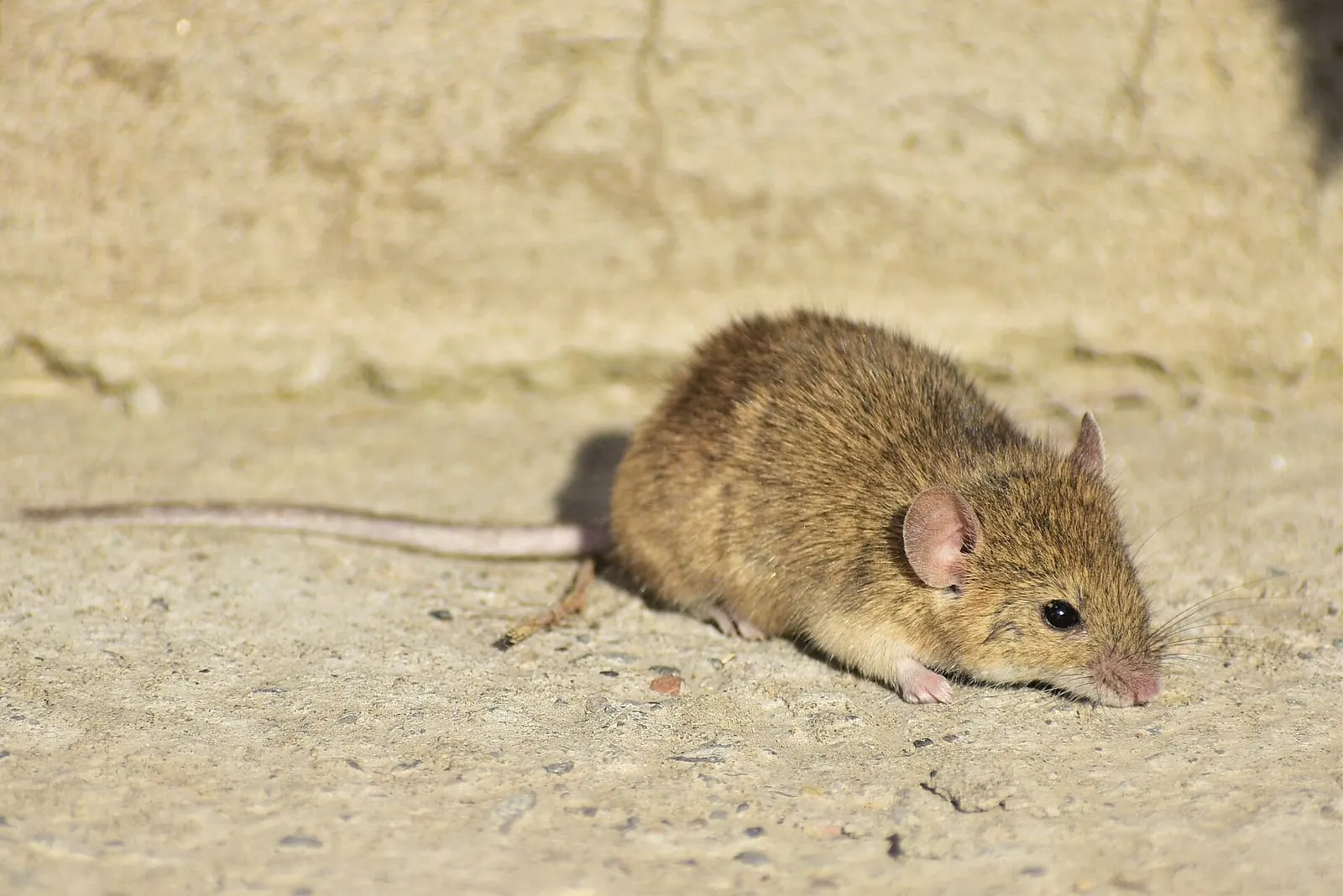


Gray from nose to tail
Most people meet a house mouse as a gray blur heading behind the stove. If you get a better look, it’s a small animal: a body around three to four inches long, a tail about that long again, and the whole thing weighing roughly half an ounce. The fur is a dull gray-brown on top and only slightly lighter underneath, with no sharp line between the two. The ears are big for the head and thinly furred, and the tail is close to bare, with faint rings you can see up close.
The dull coat is how you know it. Our native deer mouse has a brown back, a bright white belly and white feet, and a tail that’s dark on top and white underneath. If the mouse in your trap looks like it’s wearing a tuxedo, read the deer mouse page before you clean up. If it’s gray all over, it’s a house mouse, the species that crossed oceans with people and has lived with us ever since.
The droppings run an eighth to a quarter of an inch long, dark and pointed at the ends, about the size of a grain of rice. You find them where mice travel and eat: the back of the silverware drawer, under the kitchen sink, along the garage wall behind the dog food. A house mouse doesn’t wander far. UC IPM says they seldom go more than about 30 feet from their nest and food, so droppings in the pantry usually mean a nest within a room or two of it.
Why fall is mouse season in the Treasure Valley
House mice spend more of the summer outdoors than people realize, in weedy fence lines, along the edges of hay and grain fields, under sheds, in landscape rock and in the brush along irrigation ditches. A lot of new Treasure Valley subdivisions sit on ground that was farmland a few years ago, so warm crawlspaces and fresh garages are right next to fields that had plenty of mice in them.
Then the nights turn cold, usually sometime in October, and outdoor food gets scarce. A heated house with a pantry is about the best offer a mouse will ever get, which is why so many people first notice mice in the fall, often as scratching in a wall during the first chilly week.
Once inside, a house mouse has no reason to go back out. They get much of the water they need from their food, and a female can have five to ten litters a year of five or six pups each. Do the math on a single pair that slips in during October and “I’ve only seen one” stops sounding reassuring.
What they ruin, and what they carry
Most of the damage is contamination and chewing. Mice nibble at a lot of food rather than finishing any of it, so a cracker box with a chewed corner goes in the trash. They shred paper, insulation and fabric for nests, and they gnaw wiring in walls, appliances and vehicles. Engine compartments are a favorite, and our post on mice and packrats in car engines covers that headache.
Droppings and urine can carry Salmonella onto food and counters. House mice are also the main carrier of lymphocytic choriomeningitis virus (LCMV), which the CDC flags as a particular concern during pregnancy. Hantavirus is the one people worry about most, but in Idaho the strain that causes lung disease, Sin Nombre, is carried by deer mice, according to Central District Health. House mice aren’t its host.
You can’t always tell whose droppings are whose, though, so clean every mouse mess the same way: air the space out, put on gloves, soak the droppings with a bleach solution, then wipe them up with paper towels. Never sweep or vacuum dry droppings, which puts dust in the air you’re breathing. The CDC’s cleanup steps are short. Follow them exactly.
Closing the gaps before October
Walk the outside of the house with a flashlight and a pencil. If the pencil slides into a gap, a mouse can get through it.
The usual gaps are where pipes and wires go in: the AC line set, hose bibs, the gas line, the cable and internet entry. Pack them with copper or stainless steel wool, then caulk over the top so it stays put. Regular steel wool works for a while, but it rusts out in a season or two and leaves an orange streak down your siding.
If you can see daylight under an exterior door, so can a mouse, and a new door sweep costs a few dollars. On the garage door, check the corners of the rubber seal, since that’s where it tears or gets chewed first. Crawlspace and foundation vents need 1/4-inch hardware cloth over them, because mice chew right through window screen. And make sure the dryer vent flap actually closes. One that sticks open is a heated tunnel into the house.
The rest is taking away food and cover near the walls. Bird feeders spill seed that feeds mice all winter, so move them away from the house or hang a tray underneath. Keep birdseed, chicken feed and pet food in metal or hard plastic bins with tight lids. Central District Health suggests stacking firewood 18 inches off the ground; keep it away from the foundation too, and pull ivy and dense shrubs back so mice don’t have cover right up to the siding.
If the traps keep filling
Inside, plain snap traps baited with a dab of peanut butter still outperform most gadgets. Set them along walls where you’ve found droppings, with the trigger end against the wall. Our post on what to consider when you have a rodent problem goes through traps versus bait and where each makes sense.
If you’ve sealed what you can find and you’re still catching mice every week, or hearing them in more than one part of the house, book a free rodent inspection and we’ll look for where they’re getting in. Our rodent control service is usually exterior baiting, which is relatively inexpensive and works best when it’s in place before the fall push. If you’d rather ask a question first, get in touch.