
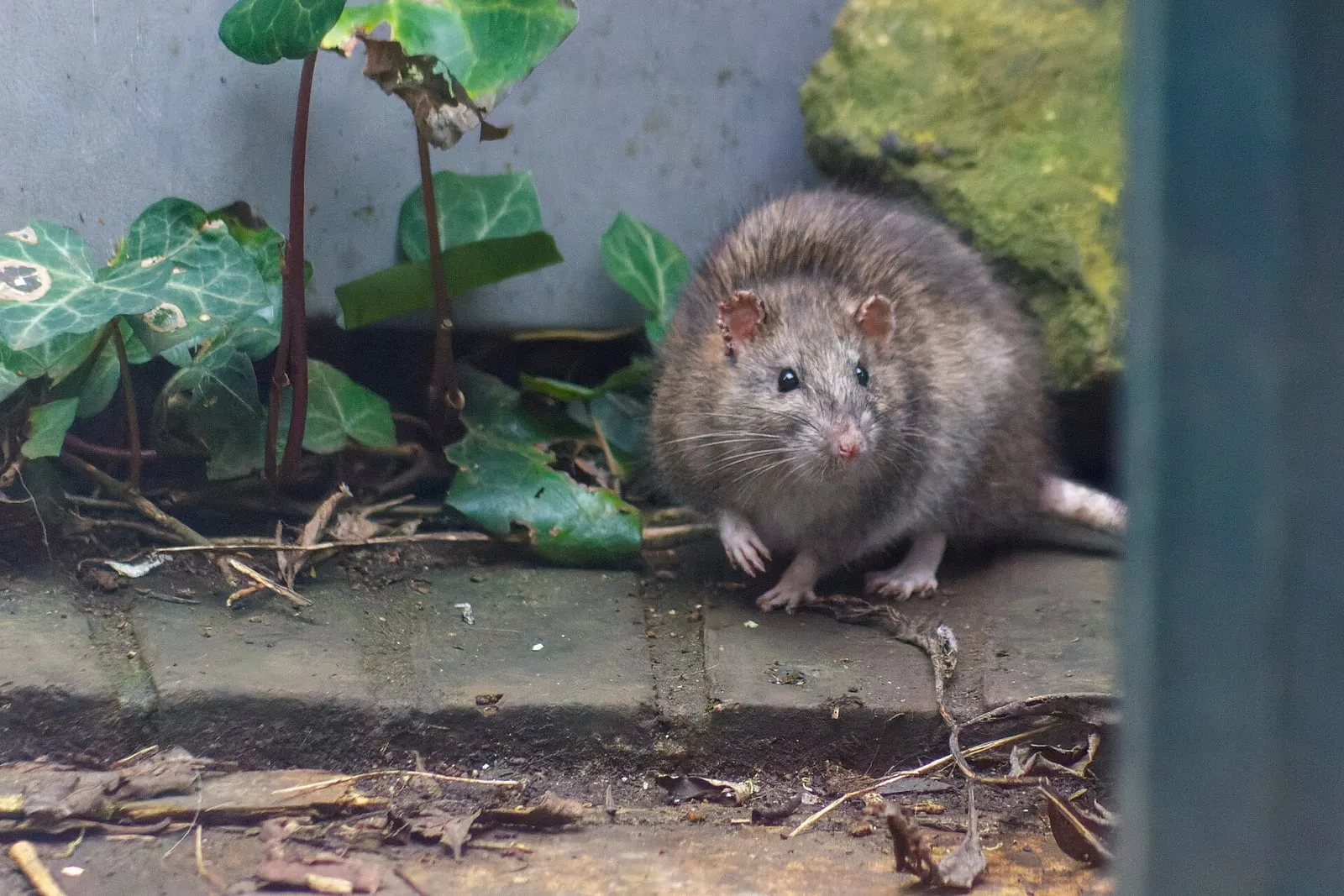


A rat built for digging
A grown Norway rat is a thick, heavy animal, around a pound on average, with a body of seven to ten inches and coarse brown or grayish-brown fur that fades to a dirty gray underneath. The nose is blunt, the ears are small and close to the head, and the tail is thick, scaly and noticeably shorter than the body. Fold the ears forward (on a dead one, please) and they won’t reach the eyes.
That build fits the lifestyle. Norway rats are burrowers and swimmers. They dig tunnels under decks, sheds, concrete pads and woodpiles, and they’re at home along water. The roof rat, its slimmer cousin, is the climber, with a tail longer than its body. If you’re watching a rat walk a power line, read that page. If you’re finding holes in the dirt, you’re probably on the right one.
Norway rat droppings can be up to three-quarters of an inch long, blunt at both ends, and they tend to show up in piles. A single rat leaves dozens a day. Mouse droppings look like rice; these look more like a fat raisin rolled into a capsule.
Rats, canals and the Treasure Valley
Until a few years ago, rats weren’t something most Boise homeowners thought about. The City of Boise now says the valley has seen “a noticeable increase in rat activity over the past few years” and names Norway rats and roof rats as the most prominent species. The Idaho Department of Health and Welfare says reports of rat sightings in the Treasure Valley have risen in recent years. Central District Health lists reports in Boise, Eagle and Garden City, and its board set aside $250,000 in 2026 for a rodent abatement and prevention project in Ada County.
Nobody has a real count, though. No agency tracks rat numbers directly, and Ada County’s weed, pest and mosquito abatement director has described the evidence that populations are growing as anecdotal. A citizen-run sighting map had logged more than 500 reports by September 2026, most of them in Ada County. That shows where people are seeing rats and bothering to report them, which is useful, but it isn’t a census.
The same abatement director has said the valley’s irrigation canals and laterals act as travel routes, and that residents who live along them report high numbers of rats. That matches how Norway rats live. They want cover, water and soft banks to dig into, and a canal is all of that plus a protected path through the neighborhood. Brushy river bottoms and ditch banks are much the same. Add backyard chickens, fallen fruit, compost piles, dog food on the patio and spilled birdseed, and a rat can find everything it needs within a few backyards.
A female has four to six litters a year of six to twelve pups, and the young can breed at about three months. At that pace a yard can go from “I think I saw something” to a real problem in one season.
Burrows, chewing and disease
Norway rats chew wood, plastic irrigation lines, insulation, door corners and wiring, and gnawed wiring in a garage or vehicle is a fire risk. Their burrows can undermine sidewalks, slabs and the soil under sheds. In a crawlspace they tear up insulation and leave droppings and urine behind.
The Idaho Department of Health and Welfare lists leptospirosis, salmonellosis, rat-bite fever and allergic reactions to rat urine among the health risks. Rats do not carry the hantavirus strains that cause lung disease; those are tied to deer mice. Clean up rat droppings the careful way anyway: ventilate, gloves on, soak with bleach solution, wipe, bag. No sweeping or vacuuming.
Making the yard less useful to rats
Rats are wary of anything new in their territory, which is part of why they’re harder to deal with than mice. Changing the territory itself does more than any one trap.
Start with food. Pick up fallen fruit and nuts. Feed pets indoors, or bring the bowl in at dusk. Chicken feed, birdseed and pet food go in metal cans with lids, and trash and compost carts stay closed. If you feed birds, put a tray under the feeder or take the winter off.
Then take away cover. Stack firewood 18 inches off the ground and away from the house, clear junk piles, old lumber and dense weeds along the fence, and trim shrubs up off the ground so you can see under them.
Rats can get under a door with a half-inch gap. Walk your foundation and seal openings around pipes, wires and vents with 1/4-inch hardware cloth, sheet metal, or copper wool and caulk. Crawlspace vents should be screened with hardware cloth, and the access door should close tight. For a shed or deck that rats keep tunneling under, burying hardware cloth along the edge, bent outward at the bottom like an L, makes digging a lot harder.
None of that holds up if the yard next door is still feeding them. Central District Health points out that rats travel well over 100 feet a night, so if the neighbor’s chicken feed is still spilled on the ground, the rats just move one fence over. It’s worth a conversation. Reporting sightings through the Idaho State Department of Agriculture’s rat page also helps local officials see where rats are spreading.
For choosing between traps and bait, read what to consider when you have a rodent problem. If you use bait yourself, keep it in a tamper-resistant station, secured so it can’t tip, and out of reach of kids, pets and wildlife.
Burrows in the yard, droppings in the garage and noises in the crawlspace are all worth a free rodent inspection, partly because Norway rats and roof rats call for different plans. If you live along a canal, our rodent control service (usually exterior baiting, and relatively inexpensive) is especially worth having. Reach out with questions.